Faced with the spectacular rise of Chinese robotics, Europe will likely not succeed by simply trying to produce more and faster. Its advantage may lie elsewhere: in robots capable of learning, designed for real-world industrial applications, and safe enough to work alongside humans.
China has once again demonstrated its ability to scale up in the field of humanoid robotics. The latest demonstrations held in Beijing showcased robots capable of running, boxing, dancing, and performing increasingly complex tasks. Behind the spectacle, the numbers point to a very real acceleration in industrial growth. According to a report presented at the World Robot Conference in Beijing, China is estimated to have shipped more than 40,000 humanoid robots in the first half of 2026. This lead deserves close scrutiny. China possesses industrial power, an electronics and automotive ecosystem, and a capacity for scaling up that Europe would find very difficult to replicate in the short term. But the spectacular images also raise another question. Is this really how the next battle in robotics will be won? For there is a considerable gap between a robot capable of impressing during a demonstration and one capable of working eight or twelve hours in a factory, learning new tasks, adapting to the unexpected, and operating safely alongside humans. And it is perhaps precisely in this gap that Europe has a role to play.From Demonstration to the Real World
We are still in an era where the performance of humanoids is largely measured by what we can see. Speed, dexterity, and physical feats have become the defining images of this new generation of robots. However, the criteria that will determine their adoption in industry will likely be far less spectacular. McKinsey estimates that robotics and Physical AI could generate at least $1,000 billion in economic value by 2040, primarily in industrial manufacturing and logistics. But the firm also highlights how far we still have to go: humanoids are still very expensive, their autonomy needs to improve, and the transition from pilot projects to full-scale production deployments requires, in particular, achieving operating times comparable to a full workday. The ability to operate safely, effectively, and economically remains an essential condition for scaling up. China itself is also beginning to formalize this new phase. Beijing is currently working to define standards for humanoids that cover not only performance and industrial applications, but also safety, ethics, and interactions in real-world environments. Competition, therefore, is no longer just about what a robot can do. It is about its ability to do so sustainably, usefully, and safely.The real leap forward could be in learning
There is another fundamental barrier to overcome. Traditional industrial robots have long excelled at performing precisely defined tasks in controlled environments. The challenge for the next generation is different: how can we enable a machine to adapt to a changing environment, understand a new situation, and acquire a new skill without requiring complex reprogramming? This is precisely what McKinsey identifies as one of the defining shifts in Physical AI. The robots of tomorrow could gradually transition from solutions designed for a specific task to machines capable of switching tasks after observing a human and adapting their behavior to the context. This evolution is essential because the real world is not perfectly predictable. Humans spend their time handling exceptions, interpreting situations, or adjusting their behavior without having precise instructions for every scenario. For robots to become truly useful beyond a few repetitive tasks, they will need to gradually acquire some of this ability to adapt. This is also the goal of the French company UMA. Unveiled this summer in Paris, its Real-Time Learning concept is based on a simple idea: rather than manually reprogramming a robot for each new application, it must be able to learn new skills through demonstration, practice them, adapt to new situations, and gradually improve its performance.The question, then, is no longer simply how many tasks a robot can perform when it leaves the factory. It becomes: How many new tasks will it be able to learn once it enters the factory?
Safety could become just as important as intelligence
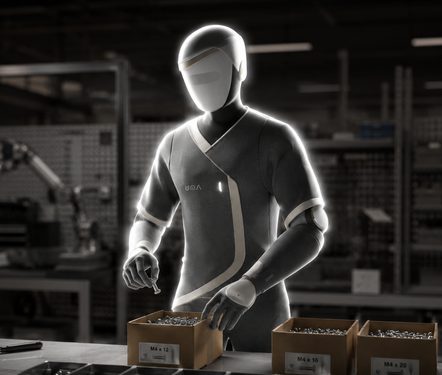
This ability to learn, however, raises a second question that is inextricably linked to the first: that of safety. A robot programmed to repeat exactly the same movement behind a safety barrier poses a relatively limited problem. An autonomous robot—capable of perceiving its environment, making decisions, and working alongside humans—poses new challenges. McKinsey also emphasizes the importance of this transition. When robots are no longer entirely deterministic, it is essential to be able to anticipate edge cases, understand their behavior when the context changes, and determine how they will interact with the people in their environment. Safety, therefore, cannot be considered a feature added only after the robot has achieved sufficient performance. It must be designed as an integral component of its architecture and intended use from the very beginning. This is yet another interesting aspect of the approach developed by UMA. The company designs its humanoids to operate in existing environments—particularly factories, warehouses, and logistics centers—and states that it develops them to function safely in the real world. This philosophy is also reflected in the robot’s physical design. UMA has opted for what it calls a “dressed machine”: human proportions, a neutral visor rather than a face intended to mimic a human, a flexible technical shell, and mechanical joints that are deliberately visible. The goal is not to hide the machine behind a human appearance, nor to optimize its design for a spectacular demonstration. Rather, it is to design a tool intended to gradually integrate into environments where people are already working. This distinction could become much more important as humanoids move from demonstration stages into factories. For the true measure of their performance may not be what they are capable of doing when everyone is watching, but how they behave—safely and reliably—when no one is watching.Europe may not need to win the battle for volume
It would be unrealistic to underestimate China’s industrial advantage. And it would be just as simplistic to portray safety as a concern exclusive to Europe. China, too, is working on the standards necessary for the large-scale deployment of these machines. The question for Europe is a different one. Should it seek to replicate the Chinese model, or can it define its own criteria for leadership in Physical AI? It has several strengths to draw on: world-class scientific research, a significant industrial base, expertise in artificial intelligence and robotics, and growing automation needs linked in particular to labor shortages. But turning these strengths into a competitive advantage will likely require choosing its battles wisely. One such battle could be in the realm of intelligence, with robots capable of learning and adapting rather than being programmed for a fixed sequence of tasks. Another could be the focus on utility, prioritizing applications capable of rapidly creating value within existing industrial environments. And the third must be safety, which is essential if these machines are truly to work alongside humans. UMA is currently a French example of this approach. The company does not claim that humanoids will replace workers on a large scale in the near future. Its vision is of machines capable of handling physically demanding, repetitive, or dangerous tasks, while allowing people to devote more time to judgment, creativity, and problem-solving. This vision has yet to be demonstrated on a large scale, as is the case for this still-young industry as a whole. But it raises an interesting question about how Europe might approach the next stage of robotics. China is now demonstrating just how quickly humanoids can be industrialized. Europe may not need to prove that it can move faster. It must show that it can build intelligent, useful, and safe machines capable of transitioning from technological feats to a lasting presence in the real world. For the true success of humanoid robotics will likely not come on the day a robot performs a new feat in front of millions of spectators. It may come on the day we stop watching it, because it will have become reliable enough, safe enough, and useful enough to simply be part of our daily work.The Author
Yana Rogers
Senior Vice President and General Manager, Outcast France
Profile and PublicationsSources
- Le Figaro / Atlantico: The Rise of Chinese Humanoid Robotics.
- McKinsey: The Age of Thinking Machines: Perspectives on the Future of Robotics
- Global Banking & Finance: UMA’s Strategy and the Non-Humanoid/Humanoid Robot.
- Sifted: UMA and Rémi Cadène.
- Business Wire: UMA Unveils Its Vision for the Next Generation of Humanoid Robots